(Above: Steve and me walking across the Brooklyn Bridge. Click on any image to enlarge.)
Last week, Steve and I spent six days in New York City. It was truly an amazing and very inspirational time. Now, many people might think that inspiration is an immediate cause-and-affect sort of situation. It's not that way for me. Rarely have I ever seen something and felt a lightening bolt of energy that makes me want to run to my studio in an attempt to make something unique. Instead, I find that inspiration is a way to creatively think about the world, my artwork, and the potential options in my future. This trip was particularly rich in thought provoking questions and personal evaluations. Yet, it was also FUN! We did so much ... both inside and outside ... like walking over the Brooklyn Bridge!
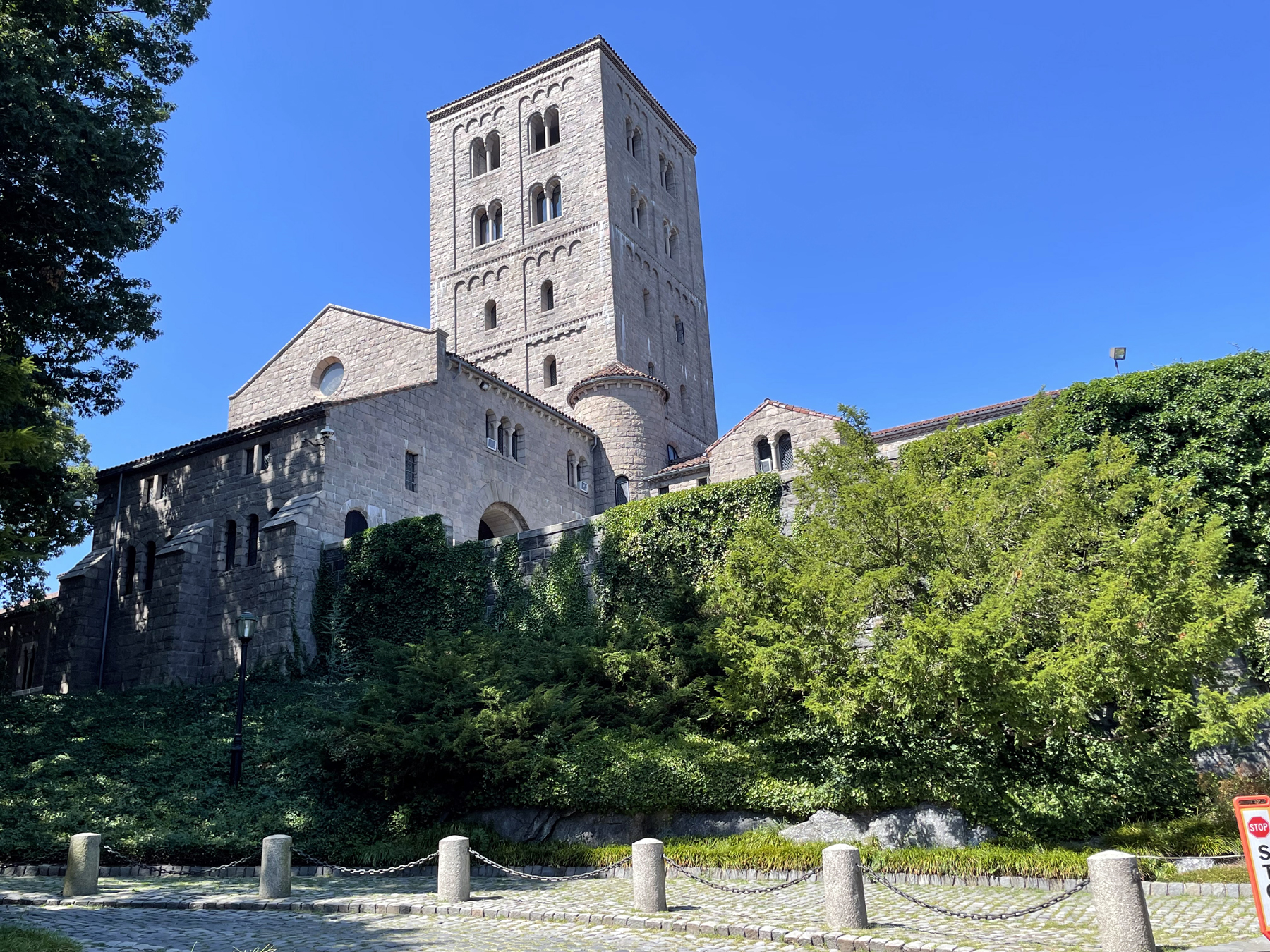
(Above: The Met Cloisters.)
After walking over the Brooklyn Bridge, we went to The Met Cloisters. We hadn't been there since 1979 while I was still pursuing a degree in Medieval and Renaissance Studies at The Ohio State University. One of my bucket list items at the time was to see the Unicorn Tapestries. It seemed as if that viewing was a long, long time ago ... forty-three years ago! Wow!
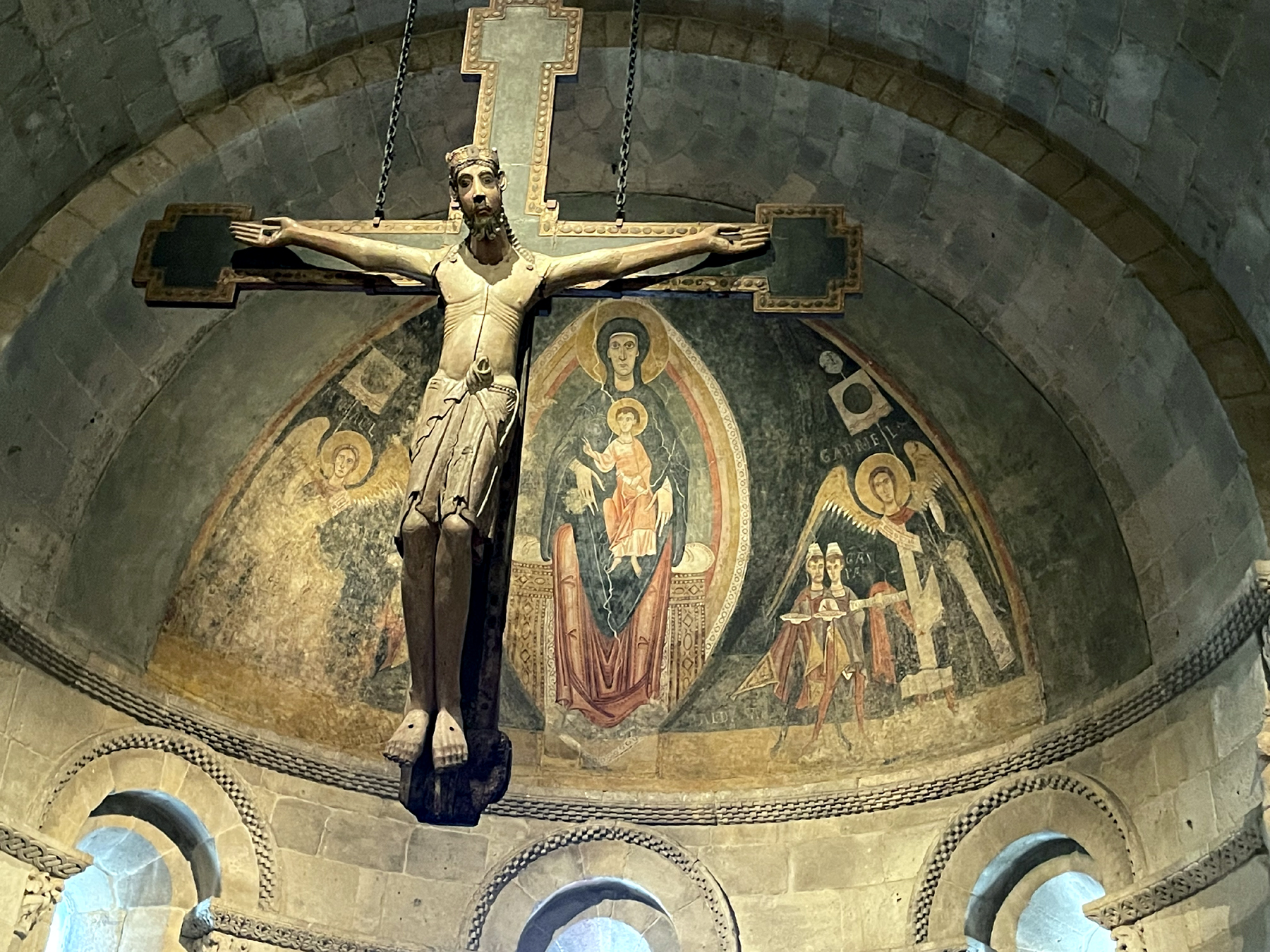
(Above: A church apse inside the Met Cloisters.)
Yet, how is this really a "long time" when surrounded by Romanesque architecture brought to this country from abroad? The quietness and sense of religious serenity make a walk through the Met Cloisters very contemplative.
(Above: A composite image of some of the sculptures at the Met Cloisters)
The archways, columns and capitals, and stained glass windows add to the feeling of awe. It was impossible not to think about the high level of craftsmanship despite the available tools, materials, and working conditions. No wonder so much of the artwork spoke to me about persistence and having faith that time will make a difference.
(Above: Detail of a stained glass window at the Met Cloisters.)
The gardens are equally beautiful and appropriately filled with plant life that was important during the Middle Ages.
(Above: Selfie with one of the Unicorn Tapestries.)
Of course we enjoyed seeing the Unicorn Tapestries again and had to snap a selfie.
In fact, we took a bunch of selfies during the week. In the image above, from top to bottom and left to right: At Finback Brewery's Tap Room, a place directly beside our hotel in Brooklyn and recommended by a participant in one of my fiber art workshop! Her son is the head brewer. The IPA was tremendous! At Grimaldi's Pizza under the Brooklyn Bridge, a place recommended by my "sister" Anabel ... and she was right! The pizza was great! At Wicked, the one Broadway show we both wanted to see. At the Neue Gallerie, a museum that doesn't allow photography at all but has a reproduction of their very famous Portrait of Adele Bloch-Bauer by Gustav Klimt that works for selfies!
(Above: One of three sculptures on the Terrace at the Whitney Biennial.)
For the most part, Steve and I went to New York City to go to museums, especially to the Whitney Biennial. We went to the last biennial (2019 ... had to skip a year due to COVID-19). A very high percentage of the artists selected in 2019 were young ... very young ... like under thirty. Though some of the work was exceptional, most didn't appeal. Thus, I had high hopes for this 2022 exhibition. I expected to see work informed by a certain advantage of maturity. I expected work to address current issues and the pandemic with thoughtfully created masterpieces. Unfortunately, I was disappointed. I haven't read any reviews yet but plan to do so. Perhaps I set the bar too high? Perhaps I simply wanted more of an "object" approached selection of artwork. I know that process and concept are extremely important and that it is still avant-garde to dismiss a physical result ... but ... well ... I still like seeing better results. Nevertheless, seeing this exhibition proved to be quite thought provoking. It stimulated plenty of good conversations while Steve and I walked through Central Park.

(Above: An altered advertisement seen in a NYC subway station.)
Frankly, this vandalized advertisement seemed more interesting than most of what I saw in the Whitney Biennial ... and it was on the wall of a subway station.
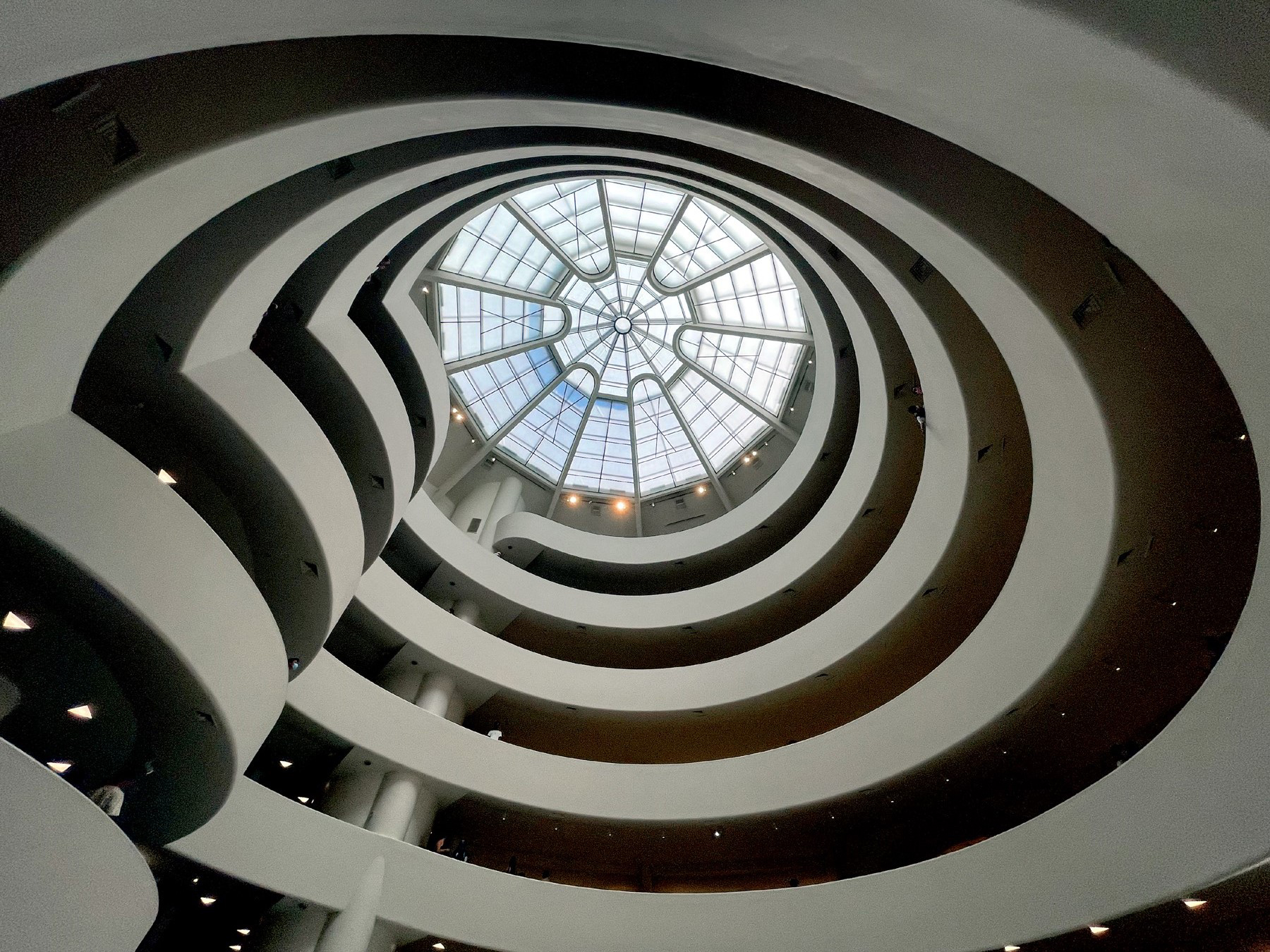
(Above: Frank Lloyd Wright's iconic spiraling architecture inside the Guggenheim Museum.)
The last time we went to the Guggenheim, Steve hated just about everything in the space. He teased me for wanting to visit, about the price of admission, and just about everything on display. The exhibit was entirely based on conceptual artwork. At the top of the spiral was a giant canvas (giant as in the size of an ordinary room's entire wall). The canvas was covered in dead houseflies. The title was Armageddon. A few of the flies had fallen to the floor. Steve started what really could have been a stand-up comedy routine. "OMG, Susan! Some of the flies are on the floor! What to do? Exactly where are the missing spots for these flies? What conservation glue is appropriate to reattach them? Who has the experience to do this restoration?" We were both laughing and almost falling into one another. A security guard started worrying and took a few steps in our direction. At that point, Steve and I quickly left via the nearby staircase. So ... going to the Guggenheim on this trip really wasn't at the top of our museum agenda. Fortunately, it was WONDERFUL! We really liked everything we saw!

(Above: Cecilia Vicuna's installation of knotted, unwoven wool, small found objects, twine, etc.)
We stared up and into Cecilia Vicuna's installation ...
(Above: One of the many Vasily Kandinsky painting on view.)
We thought the reverse chronological order to the Vasily Kandinsky exhibit heightened the stylistic changes in his artwork over time. Like most people and all art history text books, we are so used to seeing "the beginning" before the latter artwork. Looking backward in time was unique. Some people elected to ride the elevator to the top and work their way down through the exhibit. Steve and I talked about how history records time and how this might not always be the best way to view artwork. After all, we like movies that progress with multiple flashbacks. Isn't that sort of scripting a way to present a story without strictly conforming to chronological order? Isn't an artist's life a story?
(Above: Eva Hesse's
Expanded Expansions.)
Yet the most thought provoking artwork might just have been Eva Hesse's Expanded Expansions. This ground-breaking masterpiece once challenged the art world due to its unique materials and the way it just didn't neatly fit into any category. Is this sculpture? Is this craft? What are the dimensions when the work is intentionally made to expand and/or contract depending on the arrangement? When this was newly shown, it asked many questions. Now .. thirty-five years later and after having been in storage as "unexhibitable" for decades, it asks many more questions. Even while Eva Hesse was making this rubberized cheesecloth supported on polyester resin poles, she knew that the materials weren't sustainable. Over time, much of her work has darkened, lost its intended flexibility, curled into itself and crumbled. She only lived to be thirty-four years old. At the end of this short life, she was dying of brain tumor and of the opinion that these works were temporary. When questioned, she wrote: "At this point, I feel a little guilty when people want to buy it. I
think they know but I want to write them a letter and say it's not going
to last. I am not sure what my stand on lasting really is. Part of me
feels that it’s superfluous and if I need to use rubber that is more
important. Life doesn’t last; art doesn't last." It took the Guggenheim conservation staff two years to get Expanded Expansions on display. The accompanying video was very informative ... and the exhibit was surely something important to think about!

(Above: Windows reflecting in other windows along the High Line.)
Of course, Steve and I didn't spend all our time inside museums! We walked the High Line and admired all the lines of architecture ...
... and we visited the
Little Island, a new public park, a man-oasis of nature beside the riverbanks of the Hudson River.
We took in the views of skyscrapers ...
... and snapped photos of some of the carefully landscaped nature areas ...
... and we went to Long Island City to the new location of Spandex World, one of my most important suppliers. When we were last in NYC (2019), Spandex World was in the Fashion District. The pandemic forced the owners to come to terms with the high Manhattan rent. Their business is 90% on-line. The new place cost half as much for twice the space. For me ... it is simply polyester stretch velvet heaven. I got a yard of thirteen different colors. This is the material used to make my In Box and Stained Glass artworks.
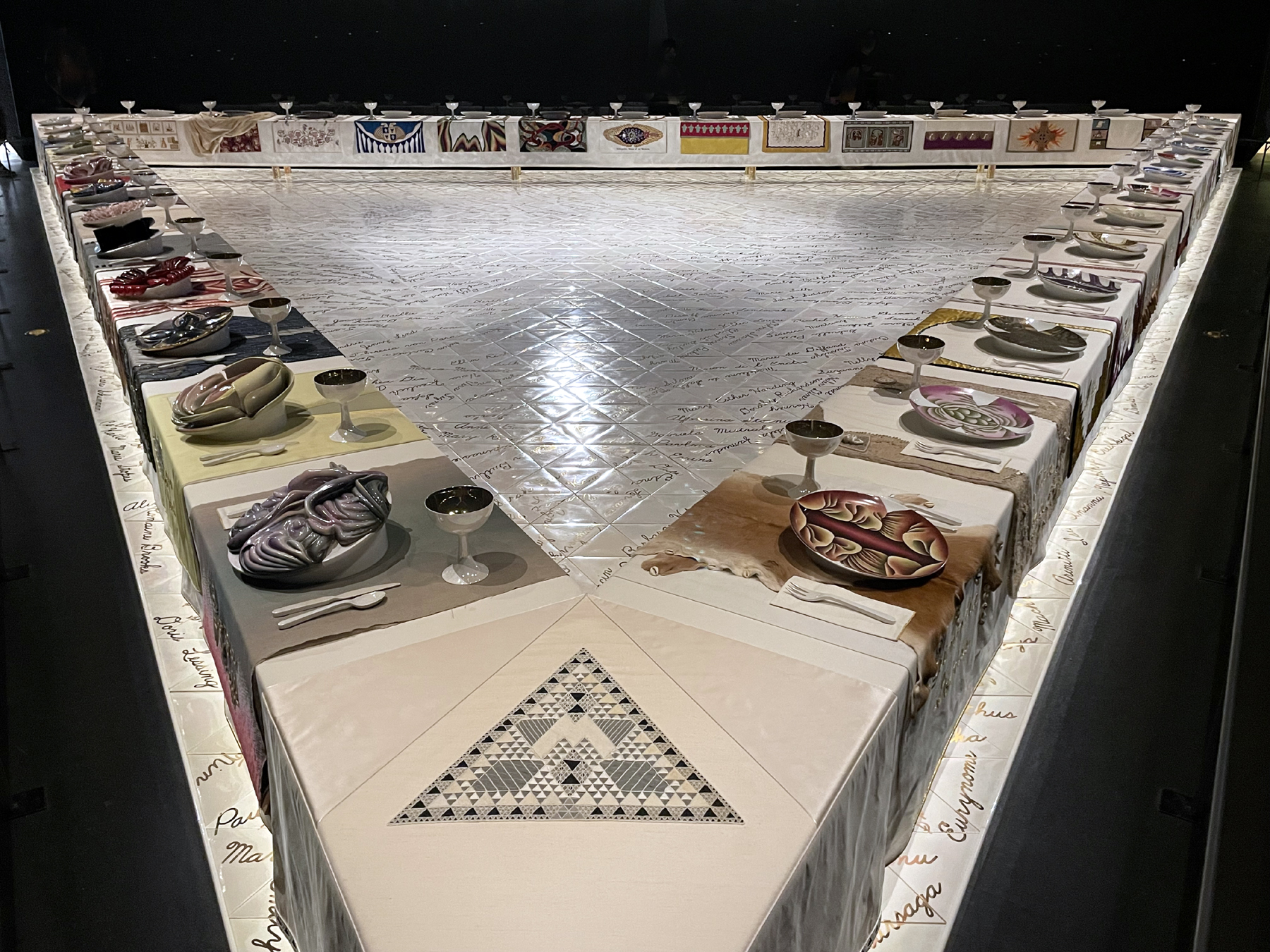
(Above: Judy Chicago's
Dinner Party.)
Steve and I got really very good at navigating the subway system. We could, however, have walked to the Brooklyn Museum of Art. Brooklyn is a great place to stay when visiting NYC. Years ago, Judy Chicago's Dinner Party was on my bucket list. So, of course, we visited it again!
It is impossible not to admire this feminine art masterpiece! The research, volunteer hours, ceramic plates, and especially the magnificent embroidery are all fabulous.

(Above: A faux-scrimshaw relic by Brooklyn-based artist Duke Riley.)
As much as I admire The Dinner Party, this visit to the Brooklyn Museum of Art will stay in my mind as the time I first encountered Duke Riley's artwork. It was grand ... and by that I mean lots of things: obsessive, hilarious, significant, accessible, entertaining, well-crafted, researched, and truly the output of a seriously focused yet fun-loving artist. I'm now a fan. I'd love to meet this man! His faux-scrimshaw relics were great! Paint, wax, and ink on single use plastics pulled from the waters around NYC. His message is all about the water ... and the bygone era of sailing ships ... and pollution ... and single use plastics ... and delving into every aspect he can when it comes to his artwork. Now ... this was an exhibit where the objects shine!
(Above: One of Duke Riley's
Sailors Valentines ... found plastics and other beach trash [including cigarette butts!] with sea shells, nubs of pencils, etc.)
How could I resist Duke Riley's Sailors Valentines? It was grand to see this! It made me think about my own Found Object Mandala and the message I have behind my work. For Duke Riley, it's all about the water and saving oceans. For me, it's all about the keepsakes and especially giving new life to old quilts ... saving them!
(Above: A selection of Duke Riley's fishing lures.)
Duke Riley obviously has a great sense of humor. All these fishing lures were made from discarded plastic tampon applicators. He's made them from syringes and cigarette lighters too. Along side this display was a giant screen showing one of his DIY videos ... literally showing how to transform a tampon applicator into a fishing lure ... and then a video of Duke and his friends catching fish with them!
(Above: The Metropolitan Museum of Art.)
Well ... I've save the Metropolitan Museum of Art the final part of this blog post. Why? Well, Steve and I bought a year membership. Steve qualifies as a "senior". The membership allows him to bring a friend each time he visits. So ... for $110 we went to The Met Cloisters and then to the giant Fifth Avenue Met every day! Still, we didn't manage to walk into every room. The place is giant-sized. It also has late hours on many days. Basically, at 5:00 PM ... we went to The Met! The membership was undoubtedly our best buy of the week ... and if we return inside of a year ... the value will only increase!
(Above: Bernd and Hilla Becher's photography exhibit.)
We first visited Bernd and Hilla Becher's strange but captivating photography show. This German couple spent their careers documenting obsolete, industrial architecture. They shot so many of these buildings that they later categorized the structures in a form of typology. For me, this statement stood out: They were constructed with no consideration of so-called beauty and serve their functionality alone. Which means that when they lose their function they are no longer entitled to exist, so they are torn down. The subject matter was indeed odd but the images were quite beautiful. Steve and I talked about function and usefulness and art and longevity.
(Above: One of the scenes from
An Anthology of Fashion at the Met. A highly fanciful presentation of the fashion event known as the
Battle of Versailles, 1973.)
We also talked about how we gravitate to curated exhibits. We like the way a good statement presents artwork in a context, shows us something new, and focuses our gaze. Such was the case with both the fashion exhibits on view. Please know, neither Steve or I really care much about fashion. Frankly, I was wearing a Carlsbad Cavern t-shirt and a jean skirt purchased from a thrift store. Yet putting fashion into the historic rooms provided new points of view, suggested secret scripts, and highlighted the marginalized people who worked nearly invisibility in the past. Many of the rooms presented as if a "freeze frame" from a movie. In fact, nine directors staged these rooms, including Sophia Coppola and Martin Scorsese! There's an excellent You Tube video ... so worth watching if you weren't as lucky as I was to see the show in person!

(Above: Two of the director staged vignettes in Anthology of Fashion.)
(Above: Three of the outfits on display with A Lexicon of Fashion.)
Steve and really liked the vignettes but were totally surprised that A Lexicon of Fashions was even more interesting. Each mannequin stood in a white scrimmed cubicle with a sign on its head. The signs each had one word ... like vulnerability, nostalgia, tenderness, care, joy, confidence, etc. The labels included the name(s) of the designer(s), materials, and a date. Most included a brief statement as to how the selected word suited the outfit. I was most taken by the use of quilts, scraps of jeans, bits of vintage lace, and embroidery!
(Above: Joy!)
(Above: Togetherness!)
We even had a another tourist take our photo!
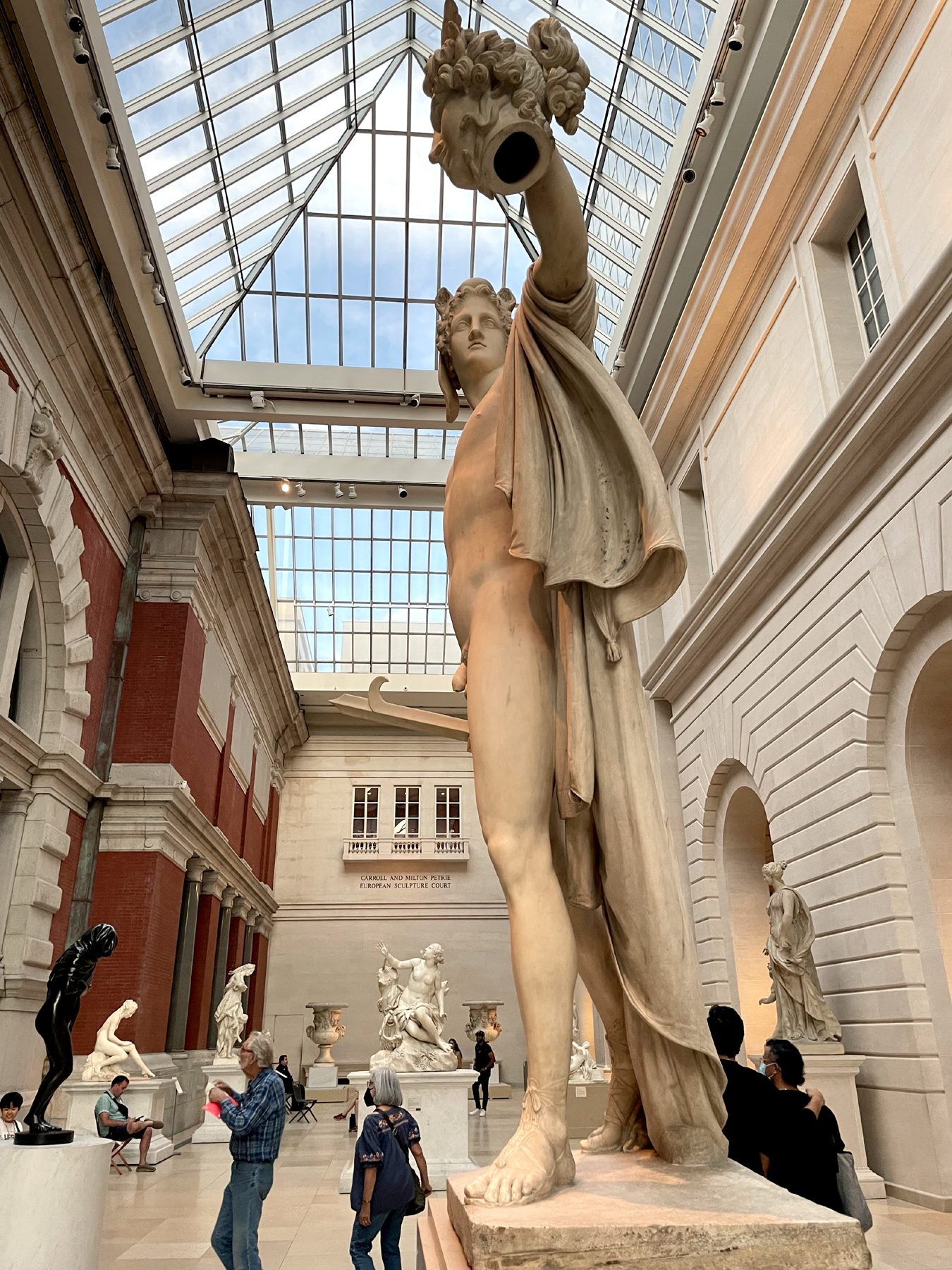
The Met is so large that it is quite easy to get lost inside the various rooms. It is also easy to become totally overwhelmed by the sheer number of beautiful things on display. Artwork at the Met comes in both mammoth and miniature sizes. It comes from every part of the globe and every era in history. The building itself is expansive and often flooded with light. Below are a few composite images of things we saw.
There's no way to give a good overview of The Met. If I lived in NYC (or within a train ride), I'd have my own annual membership and visit often. The inspiration is free though. It comes as questions, energy, and perspective. It touches me in my mind and heart. I hope to return soon!
Our week was well spent. The weather was hot but otherwise perfect. Our only chink came when at the La Guardia Airport. Of course our flight was first delayed, then rescheduled, again delayed, and finally canceled. We managed to get to DC and stay with a friend. Early the next morning, we descended into a deserted metro station before getting to the airport. The flight home was uneventful but did not include our checked suitcase. Oh well ... it came the next day. It only had dirty clothes in it anyway! Laundry can wait!
(Above: Looking down the escalator in a DC metro stop!)